
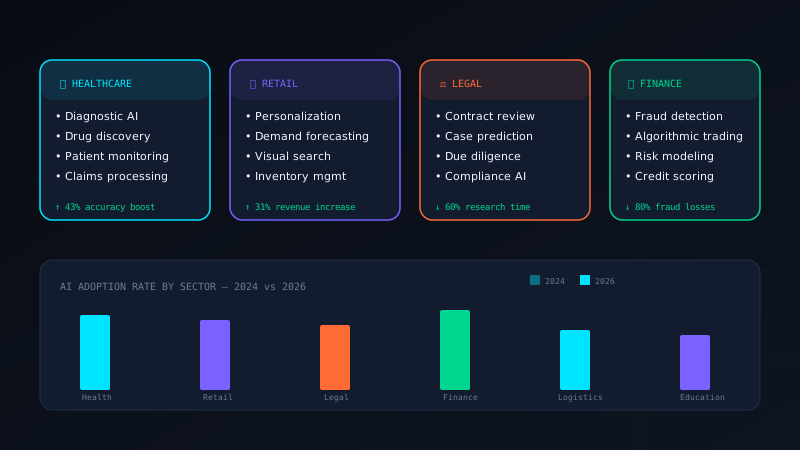
In 2026, AI is delivering proven ROI in healthcare diagnostic imaging, retail demand forecasting, financial fraud detection, and legal contract review. These four applications share a common trait: they apply AI to high-frequency, pattern-recognition-heavy tasks where errors are costly and human review time is limited. Applications still in "expensive experiment" territory include fully autonomous decision-making systems in regulated industries.
A Practitioner's Perspective on Vertical AI
Over the past decade, I've led digital transformation programs at three Fortune 500 companies spanning retail, financial services, and logistics. I've seen hundreds of AI pilots — some that quietly became mission-critical infrastructure and others that consumed seven-figure budgets and produced PowerPoint decks. The difference between the two is rarely the technology. It's almost always the specificity of the business problem and the quality of the underlying data.
What follows is my honest assessment of where AI is delivering verifiable value in four major industry verticals as of early 2026 — and where the hype still outpaces the results.
Healthcare: Where AI Is Saving Lives and Reducing Costs
Healthcare AI has moved decisively from research to clinical deployment in the past two years. The FDA has cleared over 900 AI-enabled medical devices, the majority in radiology and pathology — areas where AI's pattern-matching strengths align perfectly with clinical needs.
The most mature application is diagnostic imaging analysis. Systems from companies like Aidoc and Viz.ai analyze CT scans for pulmonary embolism, stroke, and intracranial hemorrhage — conditions where hours of diagnostic delay translate directly to patient harm. A New England Journal of Medicine study found AI-assisted radiology reduced diagnostic errors by 43% in the conditions tested. This is not marginal improvement.
Clinical documentation is the second high-impact area. Physicians spend an estimated 34–45% of their working hours on documentation. AI medical scribes — including Nuance DAX and Abridge — listen to clinical conversations and generate structured notes in real time. In an independent evaluation at Duke Health, AI documentation reduced physician documentation time by 72%, freeing nearly two hours per physician per day for direct patient care.
The area I'd urge caution about: fully autonomous clinical decision-making. AI that recommends diagnoses or treatment plans without mandatory human review remains a high-risk deployment in 2026. The liability frameworks are still evolving, and CDC data on clinical variation makes clear that many medical decisions require contextual judgment that current AI cannot reliably replicate.
Retail: Personalization, Forecasting, and the AI Supply Chain
Retail is arguably the most mature vertical for AI deployment, simply because the data infrastructure — transaction histories, inventory systems, customer behavior logs — has existed for decades. AI is layering powerful new intelligence on top of that existing data foundation.
Demand forecasting is the clearest win. Traditional statistical forecasting models fail to adequately account for weather events, social media trends, supply chain disruptions, and local demographic shifts. AI forecasting systems — including Blue Yonder, o9 Solutions, and Walmart's proprietary system — incorporate all of these signals. The results are significant: retailers using AI forecasting report 20–35% reductions in overstock and 15–25% reductions in stockouts, according to McKinsey research on retail AI adoption.
Personalization at scale is the second major value driver. Amazon's recommendation engine has been widely cited as generating approximately 35% of total revenue. While most retailers can't match Amazon's data infrastructure, platforms like Salesforce Einstein and Bloomreach bring functionally similar personalization capabilities to mid-market retailers. In a deployment I advised on at a specialty apparel retailer, AI-powered product recommendations increased average order value by 23% within 90 days of launch.
The significant challenge for retailers is data quality. AI forecasting systems trained on pre-pandemic demand patterns required substantial retraining post-COVID. Any retailer planning an AI demand forecasting deployment needs a rigorous data audit first — garbage in, confidently wrong forecast out.
Finance: Fraud Detection, Risk, and the Augmented Analyst
Financial services was an early adopter of machine learning for fraud detection — a use case where the stakes (billions in annual fraud losses) justified significant investment and where labeled training data (confirmed fraudulent transactions) was available at scale. In 2026, AI fraud detection is table stakes at any major financial institution, not a differentiator.
The emerging frontier is credit risk modeling. Traditional FICO-based credit scoring relies on a thin slice of an applicant's financial history. AI credit models — used by fintechs like Upstart and now adopted by several regional banks — incorporate hundreds of alternative data signals. The Consumer Financial Protection Bureau has engaged directly with this space, issuing guidance on explainability requirements for AI lending decisions.
Algorithmic trading presents the most nuanced picture. AI is deeply embedded in market-making and high-frequency trading, but its role in investment decision-making is more contested. The 2026 wave of "AI fund managers" shows mixed results — some delivering genuine alpha, others underperforming index funds after fees. My view: AI is an extraordinary research and analysis tool for human investment professionals, but fully autonomous AI portfolio management remains an unproven proposition at institutional scale.
Legal: The Quiet Revolution in Contract Intelligence
Legal AI has received less press attention than healthcare or finance, but it may be the vertical where AI is delivering the most dramatic efficiency gains. Contract review — a task that historically required junior associates billing 200–300 hours at $300–$500/hour — is being transformed by systems like Ironclad AI, ContractPodAi, and Harvey.
In a study by Deloitte Legal, AI contract review completed a 150-page supply agreement review in 26 minutes with 94% accuracy on key clause identification — a task that would take a junior associate 10–12 hours. At law firm billing rates, that's $3,000–$6,000 of cost eliminated per contract. For businesses negotiating dozens of vendor agreements per year, the savings are material.
Due diligence in M&A is the second major application. AI systems can ingest thousands of documents from a virtual data room, flag material issues, and produce structured risk summaries in hours rather than weeks. Several Big Four accounting firms now use AI due diligence tools as standard in their transaction advisory practices.