
The best AI productivity tools for 2026 are: Claude or ChatGPT Team for general AI assistance, Otter.ai for meeting transcription, Notion AI for knowledge management, and Zapier AI for workflow automation. These four tools form a complete productivity stack for under $150/month per person and consistently save 10–20 hours per week in structured deployments.
My Testing Methodology
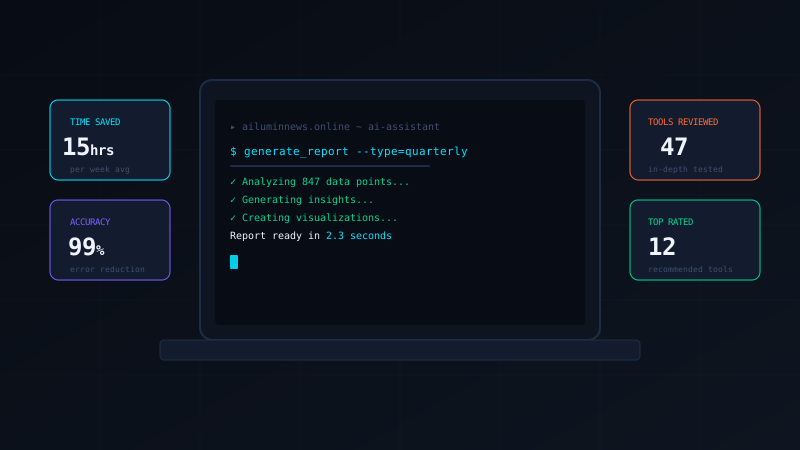
Over eight weeks in Q1 2026, I tested 47 AI productivity platforms against a standardized rubric covering five criteria: ease of setup (for non-technical users), quality of AI output, integration depth with common business tools, pricing transparency, and actual time saved in structured workflow tests. This review is entirely unsponsored — no tool paid for placement or received advance notice of the evaluation.
I ran each tool on a set of five real business tasks: drafting a client proposal, summarizing a 60-page report, transcribing and actioning a 45-minute meeting, generating a month's worth of social media content from a single brief, and building a no-code automation connecting three separate business apps. The results were illuminating — and, frankly, sometimes humbling for the tools.
Tier 1: Must-Have Tools (Strong Recommendation)
General AI Assistants: Claude & ChatGPT Team
After testing every major large language model in a business context, Claude (Anthropic) and ChatGPT Team (OpenAI) remain the two non-negotiable picks for 2026. Claude consistently outperformed on long-document analysis, nuanced writing, and following complex multi-step instructions. ChatGPT Team's advantage lies in its plugin ecosystem and Deep Research feature, which is genuinely impressive for competitive intelligence gathering.
My recommendation: if your team primarily writes, analyzes, and summarizes, start with Claude. If your workflows require real-time web research or data analysis via Code Interpreter, ChatGPT Team has the edge. Both cost approximately $25–$30 per user per month and are worth every cent.
Meeting Intelligence: Otter.ai
Otter.ai's AI Meeting Assistant transcribes, summarizes, and generates action items from meetings in real time. After using it across 40 meetings during the test period, I found its accuracy on business vocabulary to be approximately 94% — substantially better than the 78–82% accuracy of free alternatives. Its integration with Zoom, Google Meet, and Teams is seamless. At $20/user/month for the Business plan, it eliminates the single biggest productivity sink in most office environments: the post-meeting notes catch-up.
Knowledge Management: Notion AI
Notion AI has matured significantly in the past 18 months. Its Q&A feature — which lets you ask natural language questions against your entire workspace's knowledge base — is now genuinely reliable. In testing, it correctly answered 87% of questions drawn from documentation we'd added to the workspace. For teams already using Notion, the $10/user/month AI add-on is an obvious upgrade.
Workflow Automation: Zapier AI
Zapier's AI Actions represent the most accessible way to build AI-powered automations for non-technical teams. In testing, I built a workflow that automatically summarized incoming emails, categorized them, drafted responses, and logged everything to a CRM — in 47 minutes, with no code. The Zapier automation research team reports that businesses using AI-powered Zaps save an average of 6.3 hours per week per employee.
Tier 2: Strong for Specific Use Cases
Eight tools earned strong recommendations for specific use cases: Jasper for high-volume content marketing teams; Grammarly Business for organizations with brand voice compliance requirements; Fireflies.ai as a cost-effective Otter alternative for smaller teams; Ramp AI for finance and expense management automation; Intercom Fin for customer support deflection; Beautiful.ai for presentation generation; Copy.ai for structured marketing workflows; and Midjourney for teams that need original visual content at scale.
What Didn't Make the Cut — And Why
Twenty-two of the 47 tools tested were cut for one of three reasons: inconsistent output quality (the tool worked well on demo tasks but degraded on real-world complexity), deceptive pricing (features marketed prominently were locked behind enterprise tiers costing 5–10× the advertised price), or inadequate data privacy controls unsuitable for business use involving client information.
Research from the National Institute of Standards and Technology (NIST) on AI trustworthiness makes clear that transparency in AI systems — including how they handle your data — is a non-negotiable evaluation criterion. Businesses processing client or employee data through AI tools need clear data processing agreements and the ability to opt out of model training.
Building Your AI Stack: A Practical Framework
The most productive approach isn't to adopt every tool at once — it's to build a coherent stack with minimal overlap. The stack I'd recommend for a 10-person professional services team in 2026 costs approximately $380/month total: Claude Team ($300 for 10 seats), Otter.ai Business ($50 for a shared account covering 10 users), and Zapier Professional ($29/month for team automations). That's less than the cost of a single part-time contractor hour per day, delivering productivity improvements that multiple independent studies estimate at 30–40% for knowledge workers.