
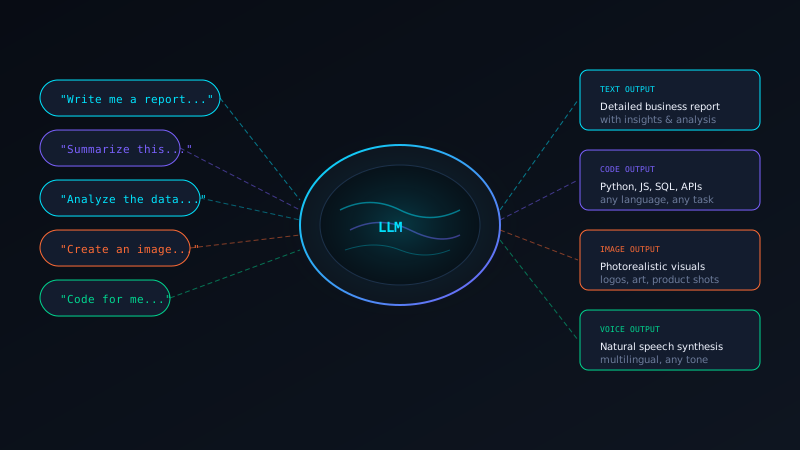
Generative AI is a category of artificial intelligence that creates new content — text, images, audio, code, and video — based on patterns learned from vast training datasets. Unlike traditional AI that classifies or predicts, generative AI produces novel outputs in response to natural language instructions. The most important business applications in 2026 are large language models (LLMs) like Claude and GPT-4, which can write, analyze, summarize, and reason across virtually any domain.
What Generative AI Actually Is — Without the Jargon
I spent twelve years working in computational linguistics and natural language processing research, including three years at Google Brain. During that time, the public understanding of AI shifted from vague science fiction to genuine business urgency. And along the way, the technical community did a poor job of explaining what these systems actually do.
Here's the clearest non-technical explanation I've found: a large language model is a system that has read approximately the same amount of text as a person would if they read every waking hour for 10,000 years. From that reading, it has built an extraordinarily sophisticated model of how words and concepts relate to each other. When you give it a prompt, it uses that model to generate a statistically plausible continuation — the text that "should" come next, given everything it has learned.
This is why LLMs are so good at so many things: translation, summarization, code generation, creative writing, analysis. The underlying statistical patterns of all of these tasks exist in the training data. And it's why they make confident errors — they're optimizing for plausibility, not truth.
The Three Types of Generative AI That Matter for Business
Large Language Models (LLMs)
LLMs — Claude, GPT-4, Gemini, Llama — are the workhorses of the current AI era. They generate text, and increasingly, reason about images, documents, and structured data as inputs. For business, they handle drafting, analysis, summarization, customer interaction, coding assistance, and research. According to research from Stanford's AI Index, LLM capability has improved more in the past two years than in the preceding decade, and adoption in enterprise contexts has tripled since 2024.
Image Generation Models
Systems like Midjourney, DALL-E 3, and Adobe Firefly generate photorealistic or artistic images from text descriptions. For business, the highest-value use cases are marketing visuals, product concept visualization, and social media content — all without stock photography licensing fees. These models have matured considerably: generating brand-consistent, commercially usable imagery is now straightforward with proper prompting.
Voice AI and Speech Synthesis
Voice AI encompasses both speech-to-text (transcription, as in Otter.ai or Whisper) and text-to-speech synthesis (ElevenLabs, OpenAI TTS). Enterprise applications include real-time translation in customer service, automated voiceovers for training content, and voice interfaces for internal tools. The quality gap between human speech and AI-synthesized speech is now nearly imperceptible for most listeners.
How LLMs Work: The 3-Minute Version
LLMs are trained on text datasets containing trillions of words — books, websites, academic papers, code repositories. During training, the model learns to predict the next word given all the words that preceded it. Repeated billions of times across massive compute clusters, this process produces a system that has internalized a remarkable breadth of knowledge about language, facts, reasoning patterns, and the structure of human thought.
The key architectural innovation behind modern LLMs is the transformer — introduced in the landmark 2017 paper "Attention Is All You Need" by Vaswani et al. The transformer's "attention mechanism" allows the model to weigh the relevance of every word to every other word in a sequence, enabling it to maintain context across long documents and conversations. This is why modern LLMs can sensibly discuss a 200-page report — not because they "read" it like a human, but because the attention mechanism allows them to identify which parts are relevant to any given question.
The Limitations Business Leaders Must Understand
The most critical limitation is hallucination: LLMs confidently generate false information when the correct answer is uncertain or absent from their training data. This is not a bug to be fixed — it's a fundamental property of systems trained to produce plausible text. Mitigation strategies include retrieval-augmented generation (RAG), where the model is connected to verified knowledge bases, and maintaining human review on all high-stakes outputs.
The NIST AI Risk Management Framework provides excellent guidance on categorizing AI risk by use case severity. Customer-facing chatbots handling low-stakes queries carry very different risk profiles than AI systems involved in medical, legal, or financial decisions — and should be governed accordingly.
The Best Starting Point for Non-Technical Business Leaders
The most effective way to develop genuine AI literacy is hands-on practice with a good LLM. Spend 30 minutes per day for two weeks using Claude or ChatGPT for your actual work tasks — drafting emails, summarizing documents, brainstorming strategies. You'll develop an intuitive sense of what these systems do well and where they fail faster than any amount of reading about them.
After that foundation, I'd recommend MIT OpenCourseWare's free introduction to machine learning (6.036) for those who want to go deeper. Understanding the technical foundations — even at a high level — makes you a substantially better consumer and supervisor of AI systems.